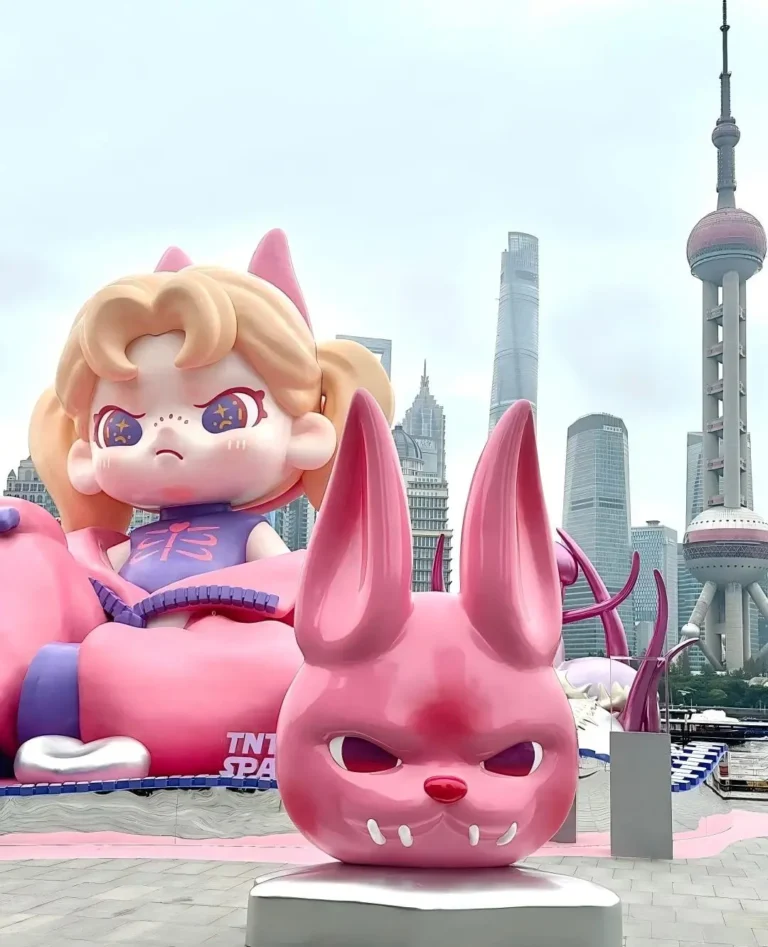
What is FRP Sculpture? A Complete Guide
FRP sculptures (fiberglass sculptures) are widely used in public art, commercial decoration, and cultural tourism settings.
Lightweight, durable, and highly versatile in design, they are gradually replacing traditional stone and metal sculptures to become the industry’s top choice.
However, many people’s understanding of fiberglass sculptures remains superficial, and they are unclear about the materials, manufacturing processes, and advantages involved.
This article will provide a comprehensive breakdown of fiberglass sculptures from the ground up, helping you quickly grasp their value and applications.
I. What is FRP Sculpture? Clarifying the Core Definition
FRP stands for Fiberglass Reinforced Plastic. FRP sculptures are three-dimensional artworks crafted using FRP as the core material through specialized processes.
They primarily consist of two components: fiberglass and synthetic resin.
Glass fiber accounts for 30%–50% of the composition, serving as the “skeleton” to provide high strength, with tensile strength far exceeding that of ordinary steel.
Synthetic resin accounts for 50%–70% of the composition, acting as the “matrix” to bind the glass fiber and transmit stress.
Small amounts of curing agents and accelerators are also added to ensure more stable sculpting.
Essentially, it is a lightweight composite material sculpture.
2. Core Characteristics of FRP Sculptures: Why Have They Become the Mainstream Choice?
The widespread application of FRP sculptures stems from their unique advantages.
These advantages set them apart from stone and metal sculptures, making them suitable for a wider range of settings.
2.1 Lightweight and High-Strength, Facilitating Easier Installation and Transportation
FRP sculptures have a density of only 1.4–2.0 g/cm³, which is one-fourth that of steel and one-eighth that of stone.
Despite its light weight, it boasts extremely high strength, with tensile strength reaching 300–500 MPa.
No heavy-duty lifting equipment is required, making installation and relocation effortless.
This significantly reduces transportation and construction costs, making it suitable for a wide range of settings.
2.2 Exceptional Malleability, Unlimited Shaping Possibilities
Before curing, the FRP material is liquid and highly fluid.
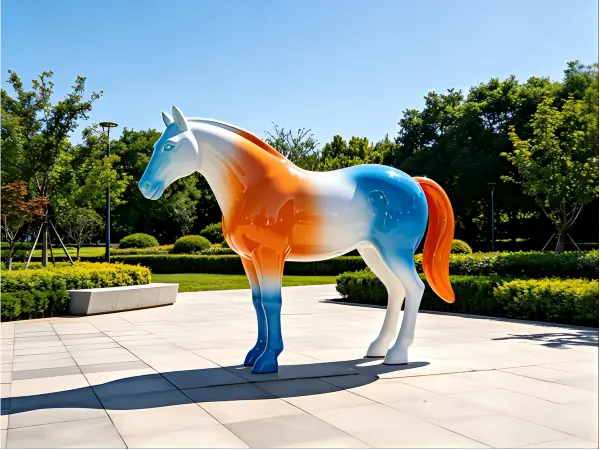
Whether it’s realistic figures or animals, or abstract art installations, it can be precisely reproduced.
It can render delicate textures with a detailed precision of up to 0.1 mm.
This is an advantage that stone and metal sculptures struggle to achieve.
2.3 Weather-Resistant and Durable, Suitable for a Wide Range of Applications
Fiberglass sculptures are weather-resistant, corrosion-resistant, and highly waterproof.
When UV absorbers are added, they can remain stable for over 10 years in environments ranging from -30°C to 80°C.
They withstand harsh conditions such as acid rain and intense sunlight, with a lifespan of over 15 years.
They are suitable for both indoor decoration and outdoor display.
2.4 Controllable Costs and Better Value for Money
Compared to bronze and marble, the raw material costs for FRP sculptures are lower.
With a short production cycle and reusable molds, they are ideal for small-batch customization.
For clients with limited budgets, they are the optimal choice.
2.5 Rich Colors and Enhanced Decorative Appeal
FRP sculptures can accurately reproduce any color or texture.
Whether it’s high-saturation cartoon colors or the look of bronze or stone, they can be precisely rendered.
With special techniques, they can even achieve dual visual effects for both day and night.
3. The Manufacturing Process of FRP Sculptures: A Complete Workflow from Design to Finished Product
Every step in the production of FRP sculptures affects both quality and service life.
The complete process consists of six steps, all of which are traceable and modifiable throughout.
3.1 Requirement Confirmation and Design Modeling
We first communicate with the client to clarify the sculpture’s purpose, dimensions, design, and budget.
Designers use professional software to create 3D models and generate renderings.
Once the client confirms the design, we proceed to the next step.
3.2 Mold Making
The mold is the core of FRP sculpture molding; its quality determines the precision of details.
There are three common types of molds: silicone molds, FRP molds, and plaster molds.
Production time ranges from 3 to 7 days, depending on the sculpture’s size and complexity.
3.3 FRP Molding
This is the core production stage, typically using the hand-layup process.
Workers lay layers of fiberglass cloth and resin inside the mold, then compress and cure the material.
Large sculptures are produced in modular sections and assembled later.
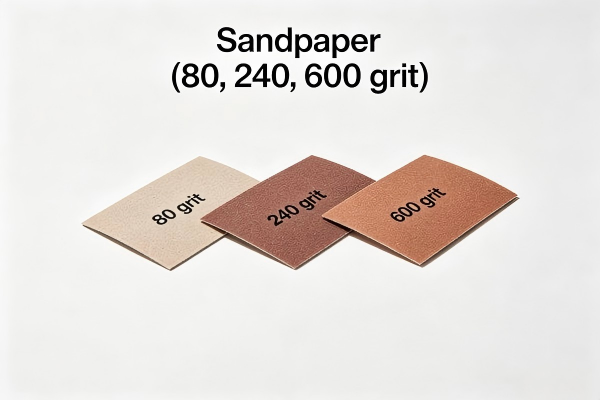
3.4 Demolding and Sanding
Once the resin has fully cured, the sculpture is removed from the mold.
The surface is sanded and polished to remove burrs and imperfections.
This prepares the sculpture for subsequent coloring.
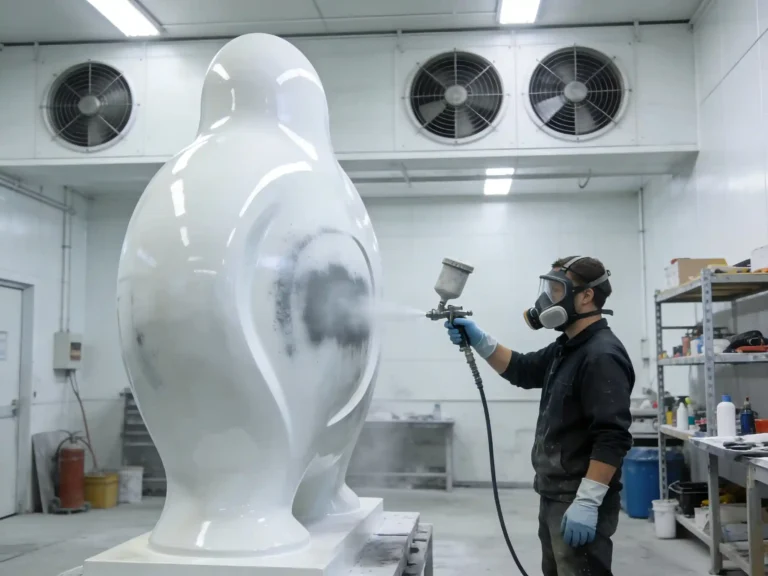
3.5 Surface Treatment and Coloring
Surface treatment and painting are performed according to customer requirements.
Common techniques include automotive paint spraying, matte spraying, and hand painting.
Outdoor sculptures are additionally coated with UV-resistant and waterproof coatings.
3.6 Quality Inspection and Acceptance
The sculpture undergoes rigorous inspection to verify its form, dimensions, and quality.
Upon passing inspection, photographs of the finished product are taken for customer confirmation.
After confirmation, the sculpture is packaged and delivered; some manufacturers offer on-site installation services.
4. Common Applications of FRP Sculptures: Where Can They Be Found?
Fiberglass sculptures have an extremely wide range of applications, spanning multiple sectors including commercial, cultural tourism, and public spaces.
4.1 Commercial Space Decoration (Core Application)
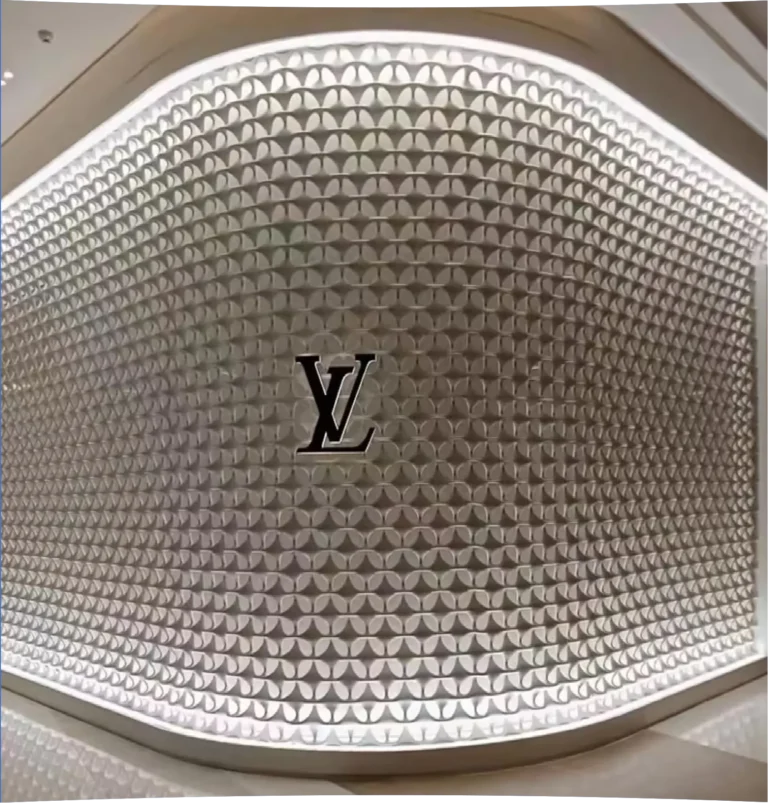
FRP sculptures are commonly used in shopping malls, hotels, office buildings, and similar venues.
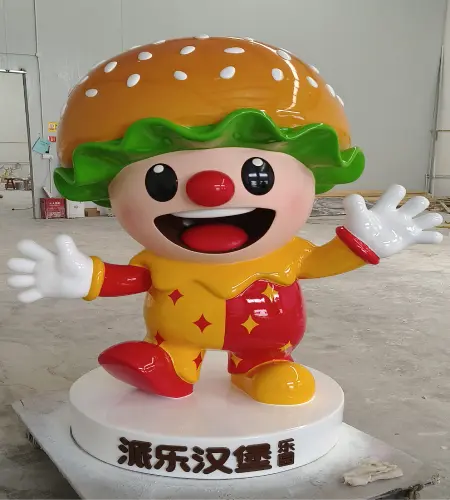
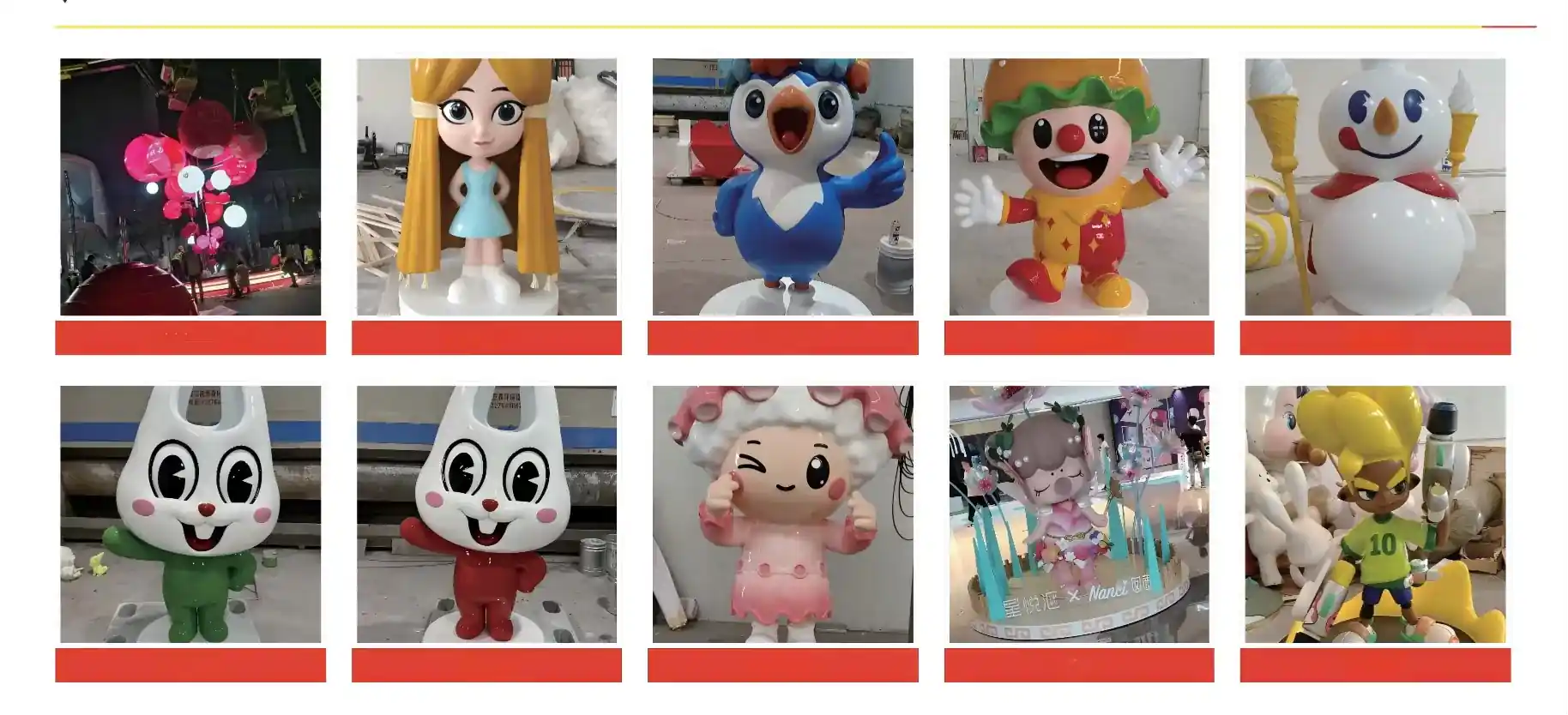
Shopping malls use brand IP cartoon character sculptures to attract customers and increase foot traffic.
Hotels use abstract sculptures to create a high-end atmosphere and showcase their style.

4.2 Cultural Tourism and Outdoor Settings
Outdoor settings such as scenic areas, parks, and theme parks are inseparable from fiberglass sculptures.
They can create distinctive landscapes and become popular photo spots.
They can also convey cultural significance and enhance the venue’s visibility.
4.3 Brand IP and Marketing Settings
Many brands commission custom FRP sculptures for promotional and marketing purposes.
For example, brand IP figures and product models can reinforce brand identity.
At trade shows and pop-up events, they can quickly attract crowds.
4.4 Public Spaces and Municipal Projects
Public spaces such as schools, hospitals, and communities also frequently utilize FRP sculptures.
They beautify the environment, convey positive energy, and enrich public cultural life.
4.5 Home Decor and Personalized Customization
FRP sculptures can also be incorporated into homes for living room and garden decoration.
Individuals and businesses can also commission custom pieces for commemorative purposes, collections, or gifts.
5. Maintenance Tips for Fiberglass Sculptures: The Key to Extending Their Lifespan
FRP sculptures are easy to maintain, but proper care can significantly extend their lifespan.
The following four tips are simple and easy to implement.
5.1 Regular Cleaning: Wipe the surface with warm water and a neutral detergent.
Avoid using strong acidic or alkaline cleaners to prevent damage to the coating.
Clean outdoor sculptures every six months; adjust the frequency for indoor sculptures as needed.
5.2 UV and Water Protection: Apply an anti-UV coating to outdoor sculptures once a year.
Provide appropriate shelter during extreme weather to prevent fading and cracking.
5.3 Avoid Impact: Prevent scratches from sharp objects and impacts from heavy items.
Handle with care when moving or relocating the sculpture.
5.4 Regular Inspections: Conduct a comprehensive inspection every 1–2 years.
Repair any cracks, peeling paint, or other issues promptly.
6. Common Misconceptions: 2 Misunderstandings About FRP Sculptures
Many people have misconceptions when selecting or using FRP sculptures.
These misconceptions can affect performance and lifespan; here’s how to avoid them.
Misconception 1: Are FRP sculptures not durable and prone to damage?
Wrong. High-quality FRP sculptures can last over 15 years; they are weather-resistant and easy to maintain.
Misconception 2: Are FRP sculptures limited to small decorative pieces?
Wrong. They can be custom-made in any size, ranging from a few centimeters to tens of meters.
7. Summary: The Core Value of FRP Sculptures and Selection Recommendations
Thanks to their numerous advantages, fiberglass sculptures have become the material of choice for modern decoration.
They combine aesthetics with practicality, making them an ideal alternative to traditional sculptures.
When purchasing or customizing fiberglass sculptures, keep two points in mind:
First, choose a reputable and experienced manufacturer to ensure quality materials and craftsmanship.
Second, clearly define your specific needs to avoid making a blind choice.
Whether for commercial decoration, cultural and tourism landscapes, or personalized customization, fiberglass sculptures can enhance the texture and character of any space.
We hope this analysis helps you gain a comprehensive understanding of fiberglass sculptures and make the most of them.