Fiberglass vs Resin for Art Sculpture: Which Should You Choose?
Choosing the right material is one of the most important decisions when developing an art sculpture. The material affects not only the appearance of the finished artwork, but also its weight, structural performance, durability, transportation, fabrication process, cost, and installation requirements.
For contemporary artists, two commonly considered options are fiberglass-based composite materials and resin-based materials. But choosing between them is not always straightforward.
So, fiberglass vs resin for art sculpture: which should you choose?
The answer depends on the concept and requirements of the artwork. A small indoor sculpture may have very different material requirements from a large outdoor installation. Likewise, an artist who wants transparency and depth may have different priorities from an artist creating a monumental sculpture with complex geometry.
This guide compares fiberglass and resin for art sculpture and explains the main factors artists should consider before starting fabrication.
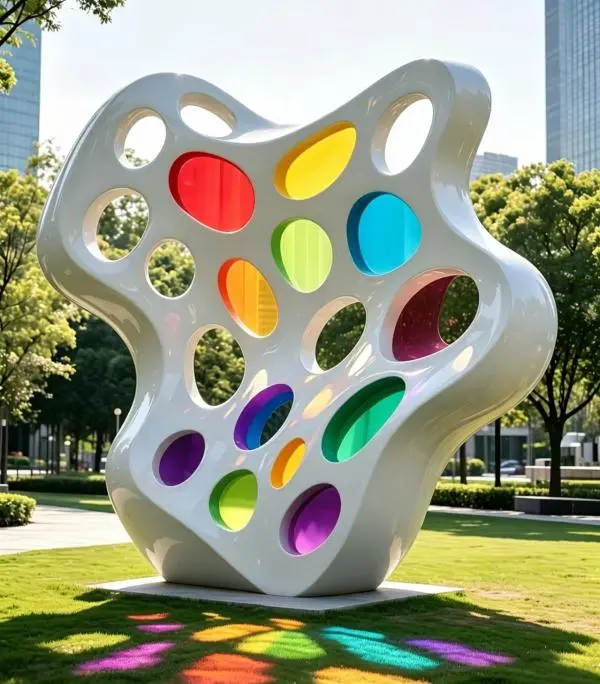
Fiberglass and Resin: What Is the Difference?
Before comparing the two materials, it is important to clarify one common source of confusion.
Fiberglass and resin are not always completely separate materials.
In fiberglass-reinforced plastic, commonly known as FRP, glass fibers are combined with a polymer resin. The fiberglass provides reinforcement, while the resin binds the composite structure together.
As a result, a fiberglass-based sculpture can actually contain resin as part of its construction system.
When artists talk about a “resin sculpture,” however, they may be referring to a sculpture made primarily from a cast or molded resin system, such as epoxy, polyester, polyurethane, or another specialized polymer.
Therefore, the real comparison is often between different material systems and fabrication methods, rather than simply fiberglass versus resin as two completely unrelated substances.
Understanding this distinction can help artists make a more informed decision.
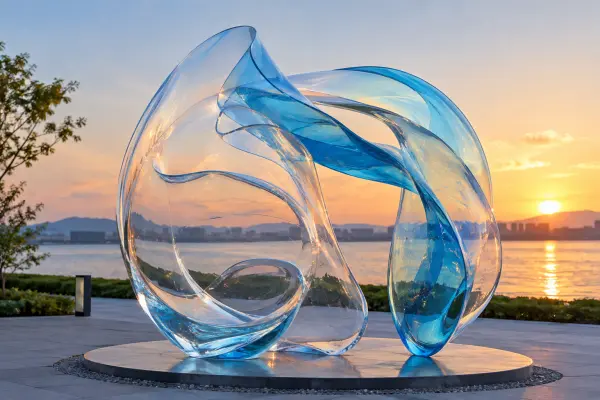
Fiberglass vs Resin for Art Sculpture: Key Factors
When selecting a sculpture material, there is no single factor that determines the best option.
Artists should consider several aspects together, including:
- Sculpture size
- Weight
- Structural requirements
- Surface appearance
- Transparency
- Outdoor exposure
- Transportation
- Mold requirements
- Production quantity
- Installation
- Budget
- Long-term maintenance
Let’s examine each factor in more detail.
1. Weight and Large-Scale Sculpture
Weight is particularly important when an artwork becomes large.
A solid polymer sculpture can become relatively heavy as its dimensions increase. This can affect transportation, handling, installation, and structural requirements.
Fiberglass-reinforced construction provides an alternative approach. Instead of producing a sculpture as a completely solid mass, fabricators can create a hollow composite shell supported by reinforcement and, when necessary, an internal framework.
This approach can significantly reduce the amount of material required while maintaining the desired shape and structural performance.
For this reason, fiberglass-based construction can be particularly practical for:
- Large contemporary sculptures
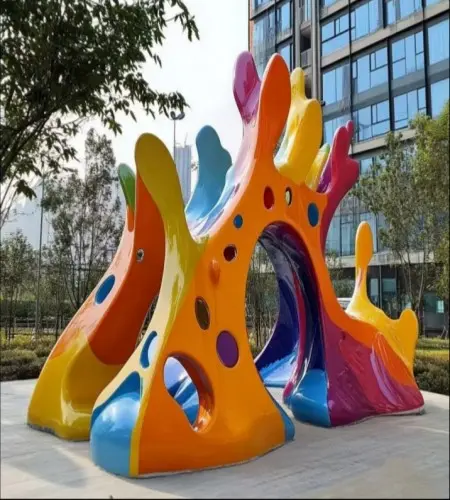
- Public art
- Outdoor installations
- Hotel and commercial sculptures
- Oversized character sculptures
- Exhibition displays
- Architectural sculptures
For a small artwork, weight may not be a major concern. For a sculpture several meters high, however, it can become a critical part of the design.
2. Structural Strength
Structural requirements are another important consideration.
A sculpture may need to withstand its own weight, transportation, installation, wind loads, handling, or other physical stresses depending on where it will be displayed.
Fiberglass reinforcement can be incorporated into a composite structure to improve its strength relative to an unreinforced resin casting.
Large sculptures can also incorporate internal steel or other structural frameworks.
The result is a system in which different materials perform different functions:
Outer surface → visual appearance
Fiberglass composite → shell and reinforcement
Internal frame → structural support
This approach can be especially useful for large or complicated forms.
For smaller artworks where structural demands are limited, a cast resin system may provide sufficient performance and may offer visual characteristics that are more important to the artist.
3. Sculpture Surface Finish and Visual Appearance
The final appearance of a sculpture is often just as important as its structural performance.
Both fiberglass-based and resin-based sculptures can be finished in many different ways, but their visual possibilities can differ.
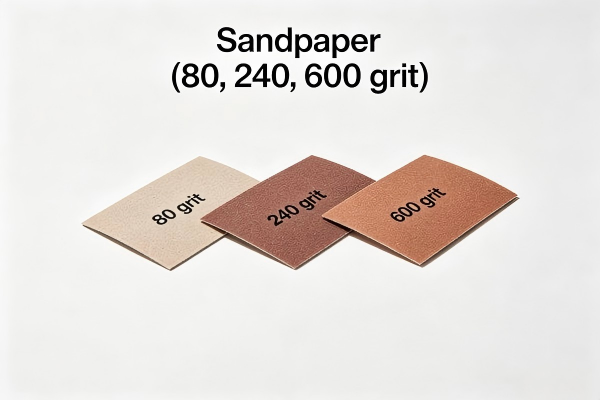
Fiberglass composite surfaces can be sanded, filled, primed, painted, textured, polished, or coated.
This makes the material suitable for artists who want a specific color, texture, metallic effect, matte surface, high-gloss finish, or painted appearance.
Resin can offer other visual possibilities.
Certain resin systems can be transparent or translucent and may allow artists to create:
- Glass-like effects
- Internal depth
- Translucent forms
- Encapsulated objects
- Layered colors
- High-gloss surfaces
- Optical effects
Therefore, if the material itself is intended to become part of the visual concept, resin may provide an important creative advantage.
If the artwork will ultimately be painted or coated, the difference may be less significant because the final surface treatment becomes a major part of the appearance.
4. Transparency and Translucency
Transparency is one of the clearest differences between some resin applications and traditional fiberglass composite construction.
Artists working with transparent or translucent sculpture may specifically select a resin system because light can become part of the artwork.
For example, an artist may want:
- Light passing through the sculpture
- A translucent colored surface
- Objects suspended inside the material
- Layered visual depth
- Internal illumination
- A glass-like appearance
In these cases, a suitable clear or translucent resin system may be more appropriate than a conventional opaque fiberglass composite.
However, transparency is not necessarily the deciding factor for most large painted sculptures.
For those projects, structural efficiency, weight, fabrication complexity, and surface finishing may be more important.
5. Outdoor Sculpture and Environmental Exposure
Outdoor art requires more planning than indoor sculpture.
A sculpture installed outdoors may be exposed to:
- UV radiation
- Rain
- Humidity
- Temperature changes
- Wind
- Dust
- Pollution
- Physical contact
The long-term behavior of polymer-based materials depends on their specific chemical formulation, reinforcement, coatings, environmental conditions, and maintenance.
Therefore, artists should avoid assuming that every resin or every fiberglass system has the same outdoor performance.
Instead, ask the fabricator about the complete material system.
Important questions include:
- What resin system will be used?
- What type of fiberglass reinforcement is appropriate?
- Will the sculpture have an internal frame?
- What protective coating will be applied?
- How will water be prevented from accumulating?
- Is the surface designed for the expected environment?
- What maintenance will be required?
For permanent outdoor installations, these questions should be discussed before fabrication begins.
6. Mold Making and Complex Shapes
Both fiberglass and resin can be used with molds, making them suitable for complex sculptural forms.
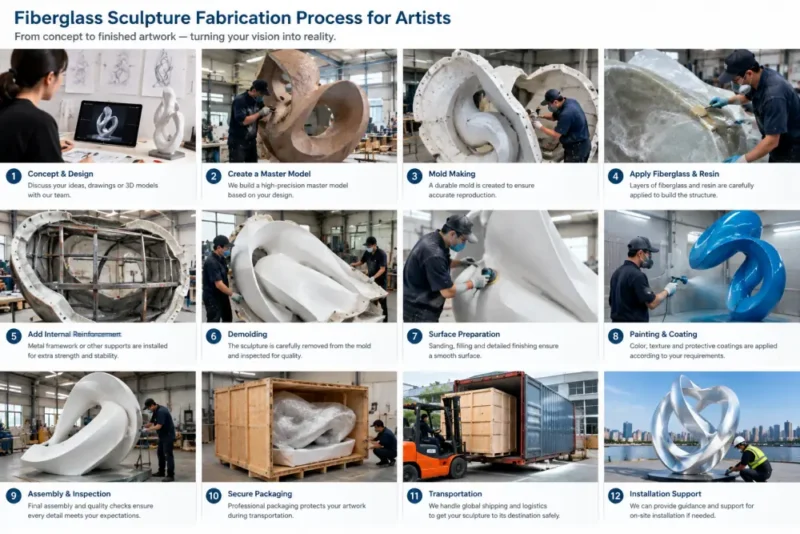
A typical fabrication process may include:
- Concept development
- 3D modeling or traditional sculpting
- Prototype or master model
- Mold production
- Material application or casting
- Reinforcement
- Demolding
- Surface preparation
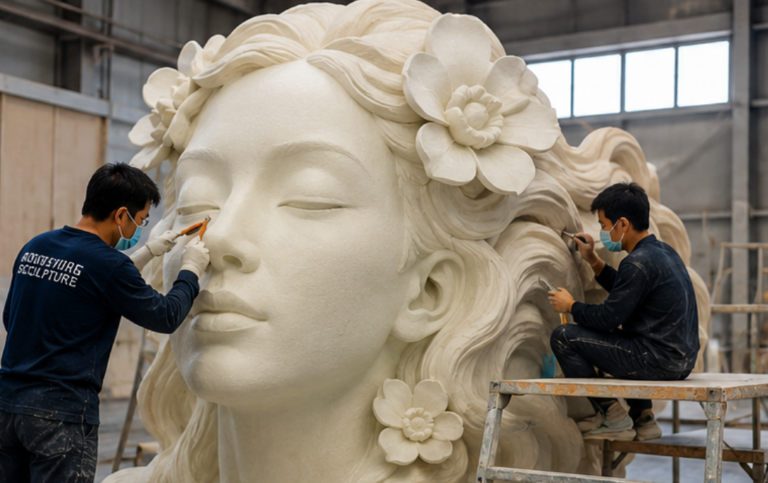
- Sanding and finishing
- Painting, coating, or polishing
- Assembly
- Inspection and packaging
The specific workflow depends on the artwork.
For complex contemporary sculptures, digital modeling and large-format 3D printing can also be integrated into the process.
For example, a digital sculpture can be divided into manageable sections, printed at large scale, refined, used to create molds, and then reproduced using the selected composite or resin system.
This can provide artists with more flexibility when developing unusual forms.
7. Transportation and Installation
Transportation is often overlooked during the early stages of sculpture design.
A sculpture that looks perfect in a studio may become difficult to ship if it is too heavy, too large, or impossible to disassemble.
Fiberglass construction can provide advantages for large sculptures because lightweight hollow sections can be produced and assembled later.
Large artworks may also be divided into multiple components.
This can make it easier to:
- Fit the artwork into shipping containers
- Reduce transportation weight
- Handle individual sections
- Protect delicate surfaces
- Simplify installation
- Replace individual components if necessary
For international art projects, transportation should ideally be considered before fabrication rather than after the sculpture is completed.
8. Cost Considerations
Material cost is only one part of the total sculpture budget.
Artists should consider the complete fabrication process, including:
- Master model production
- 3D modeling
- 3D printing
- Mold making
- Materials
- Internal structure
- Labor
- Surface finishing
- Painting
- Packaging
- Transportation
- Installation
A material that appears inexpensive at the raw-material level may not necessarily produce the lowest total project cost.
For example, a large sculpture may require significant amounts of solid resin, while a lightweight fiberglass construction may use a hollow structure with reinforcement.
On the other hand, a small sculpture with a highly polished or transparent finish may require substantial labor during resin casting and finishing.
Therefore, artists should compare total fabrication cost, not simply the price per kilogram of material.
Fiberglass vs Resin for Different Types of Art
The right material can change depending on the type of artwork.
Large Contemporary Sculpture
For large contemporary sculptures, a fiberglass-reinforced composite system can be highly practical because it can provide a lightweight shell with structural reinforcement.
This can be useful when the sculpture needs to be transported or installed at a large scale.
Small Gallery Sculpture
For smaller gallery works, the artist may have more freedom to choose based on visual appearance.
If transparency, depth, or encapsulation is important, resin may be particularly attractive.
Outdoor Public Art
Outdoor public art requires careful consideration of structural support, environmental exposure, coatings, installation, and maintenance.
A fiberglass composite system with an appropriate protective finish and structural framework may be considered when weight and scale are important.
Commercial and Architectural Sculpture
Hotels, shopping centers, restaurants, offices, theme parks, and other commercial environments may require sculptures that are large, lightweight, durable, visually consistent, and relatively easy to install.
Fiberglass-based fabrication can be suitable for many of these applications.
Conceptual and Experimental Art
For experimental artworks, material selection should follow the artistic concept.
If the artist wants the material itself to create visual effects, resin may offer useful possibilities.
If the concept requires monumental scale and complex geometry, fiberglass or a hybrid material system may be more practical.
Fiberglass or Resin for Sculpture: Which Should Artists Choose?
There is no universal answer.
Instead, artists can start by asking five basic questions:
1. How large is the sculpture?
If the sculpture is very large, weight and structural requirements become increasingly important.
2. Where will it be installed?
An indoor gallery, outdoor plaza, hotel lobby, and public park can require very different material strategies.
3. What should the surface look like?
If the artwork requires transparency or translucency, a suitable resin system may be appropriate.
If the sculpture will be painted, metallic-coated, or textured, fiberglass composite construction may provide considerable flexibility.
4. Does the sculpture need to be transported internationally?
If yes, weight, sectional construction, packaging, and assembly should be considered during design.
5. Is the material itself part of the artistic concept?
If the answer is yes, the optical and tactile characteristics of the material may become more important than fabrication efficiency.
These questions can help artists narrow down the appropriate material system before production begins.
Why Work With a Professional Sculpture Fabricator?
Material selection is only the beginning.
The quality of the final sculpture also depends heavily on mold making, reinforcement, surface preparation, finishing, assembly, and quality control.
A professional custom fiberglass sculpture manufacturer can help artists turn a concept, sketch, clay model, or digital file into a finished physical artwork.
Depending on the project, fabrication may include:
- 3D modeling
- CNC machining
- Large-format 3D printing
- Prototype production
- Mold making
- Fiberglass lamination
- Resin casting
- Metal framework fabrication
- Surface finishing
- Painting
- Polishing
- Assembly
- Packaging
For artists working internationally, fabrication partners may also need to consider export packaging and transportation requirements.
Sculpture Fabrication for Artists
Professional sculpture fabrication for artists should begin with the artist’s creative concept rather than simply selecting a material from a standard product list.
A fabrication partner should understand what the artist is trying to achieve and then determine how the sculpture can be physically produced.
Before fabrication begins, artists should provide as much information as possible about:
- Overall dimensions
- Reference drawings or images
- 3D files, if available
- Materials or visual references
- Surface finish
- Installation environment
- Quantity
- Delivery location
- Installation requirements
- Desired production schedule
The fabricator can then evaluate the production method and recommend an appropriate material and construction strategy.
This collaborative process can be particularly valuable for contemporary artists because many artworks do not fit into a standard manufacturing category.
Can Fiberglass and Resin Be Used Together?
Yes.
In fact, combining different materials can sometimes be the most practical solution.
For example, a sculpture may use:
Fiberglass composite for the outer shell.
Resin for selected transparent or decorative elements.
Steel for the internal structural framework.
Specialized coatings for the final surface.
This approach allows the artist and fabricator to assign different functions to different materials.
Instead of asking whether fiberglass or resin is universally better, the more useful question may be:
Which material should be used for each part of the sculpture?
This approach can provide much greater creative and engineering flexibility.
Fiberglass vs Resin Comparison Table
| Factor | Fiberglass-Based Composite | Resin-Based Sculpture |
|---|---|---|
| Large-scale artwork | Well suited to many large projects | Depends on construction method |
| Weight | Can be relatively lightweight | Solid casting can be heavier |
| Structural reinforcement | Can incorporate fiberglass and internal frameworks | Depends on formulation and design |
| Complex forms | Suitable | Suitable |
| Transparent effects | Generally limited in conventional opaque systems | Suitable for appropriate clear systems |
| Painted finish | Highly suitable | Suitable |
| Glossy finish | Possible with appropriate finishing | Often suitable |
| Outdoor applications | Possible with appropriate material and coating | Depends on resin and protective system |
| Transportation | Lightweight sectional construction can be advantageous | Weight may increase with solid construction |
| Mold production | Suitable | Suitable |
| Reproduction | Suitable for molded production | Suitable for molded production |
| Best suited to | Large forms, installations, public art, commercial sculpture | Cast works, transparent effects, smaller works, experimental applications |
The table should be viewed as a general comparison rather than a universal rule. The actual performance of a sculpture depends on the specific material system, fabrication technique, structural design, finishing system, and installation environment.
Frequently Asked Questions
Is fiberglass or resin better for art sculpture?
Neither material is universally better. The appropriate choice depends on the sculpture’s size, design, surface requirements, installation environment, structural needs, budget, and transportation requirements.
Is fiberglass lighter than solid resin?
A fiberglass-reinforced sculpture can be fabricated as a lightweight hollow shell, while a solid resin sculpture may become considerably heavier as its size increases. The actual weight depends on the construction method and material system.
Can FRP sculptures be used outdoors?
Yes, fiberglass-based sculptures can be designed for outdoor applications when an appropriate material system, structural design, protective coating, and maintenance plan are used. Outdoor performance should be evaluated based on the complete fabrication system rather than the material name alone.
Can resin be used for large sculptures?
Yes, but the appropriate resin system and construction method depend on the sculpture’s dimensions, structural requirements, weight, and intended environment. Large resin-based artworks may require reinforcement or a supporting structure.
Can fiberglass and resin be combined in one sculpture?
Yes. Fiberglass-reinforced composite construction already uses resin as part of the composite system, and separate resin elements can also be incorporated into a sculpture when the design requires specific visual or structural properties.
What should artists consider before choosing a sculpture material?
Artists should consider size, weight, structure, surface finish, transparency, installation environment, transportation, production quantity, budget, maintenance, and the intended visual effect.
Conclusion: Choosing the Right Material for Your Sculpture
The question of fiberglass vs resin for art sculpture does not have one universal answer.
Fiberglass-based composite construction can be particularly useful for large, lightweight, complex, and transportable sculptures. Resin-based materials can provide valuable creative possibilities when transparency, translucency, depth, gloss, or encapsulation is an important part of the artwork.
For some projects, the best solution may be a combination of fiberglass, resin, metal, coatings, and other materials.
The most important step is therefore to start with the artwork itself.
Consider its size, artistic concept, surface appearance, installation environment, structural requirements, transportation needs, and long-term maintenance. Then select the material and fabrication method that best supports those requirements.
For contemporary artists, working with an experienced fiberglass sculpture manufacturer can also make the process more efficient. A professional team can evaluate the design, recommend suitable materials, develop molds or prototypes, manage structural requirements, and produce the final artwork according to the artist’s specifications.
Ultimately, the right material is not simply the one with the lowest cost or highest strength. It is the material system that allows the artist’s creative concept to become a practical, durable, and visually successful finished sculpture.
Share your design requirements and project scale. Our team will provide a free design evaluation and competitive quotation for your custom sculpture project. Contact us today to get started.